We arrived at Viwinco with the confidence that experienced lean coaches usually bring. The problem looked straightforward: they were laminating two pieces of glass with a polyvinyl butyral (PVB) interlayer, and they were getting bubbles.
In the traditional lean playbook, the answer is almost always "standardized work." Watch the operator. Find the variation. Lock it down.
But the glass didn't care about our standard work.
Viwinco operates in a high-mix, make-to-order niche. To improve flow, they had invested in a vacuum-seal machine to replace the industry-standard autoclave process. Instead of relying on long cycles of pressurized heat, this new equipment used a combination of vacuum pressure and heated irons to evacuate air while compressing the glass.
It sounds simple. But as we listened to the veterans who had wrestled with this machine since installation, we found scar tissue. Months of fighting an unpredictable process had created a reluctance to experiment. They had finally clawed their way to some level of stability — getting defects under 3% — and they were nervous to touch it. Deep into the first day, the reality set in: We weren't dealing with an operator standard work problem. We were dealing with a materials science problem. Moisture absorption. Vacuum timing. Thermal conductivity. Building understanding around the science felt like a missing component.
I had a realization. I only have three days. How can I help add value, improve capability, and autonomy in a meaningful way that will genuinely help?
Even if I had a solid grasp of the chemistry and process (which I didn't), I couldn't teach the team years of polymer chemistry knowledge, special cause vs. common cause variation, critical control points validation, and statistical process control in 72 hours. Even the machine manufacturer and materials supplier who were there with us acknowledged the limitations of the new technology and materials. If I leave Andy (the glass value-stream manager) with just a "mindset," some standardization tips, some experiments, and sticky notes, I am failing him.
The Capability Gap
This is where short-term lean coaching narrowly focused on operator standardized work and 5S breaks down. We can tell leaders to "go see," "problem solve," and "experiment," but you can't problem solve a materials science issue if you can't grasp the science.
The gap wasn't motivation. The gap was technical capability.
AI isn't about replacing the expert. It's about lowering the threshold where expertise becomes irreplaceable.
To bridge this gap, I turned to the tools at hand. I fired up Claude and activated "Deep Research" mode, asking it to scour the web for technical articles on vacuum lamination processes. Ninety minutes later, it had curated a robust list of technical journals, supplier manuals, and independent testing results.
I sorted through the resources, pulling the most applicable files into a custom "Project" to serve as a knowledge base. I spent the evening interrogating this new digital expert, trying to grasp the physics myself. It confirmed my suspicion: the variables were far more complex than our experiments were accounting for.
But walking in the next morning and saying, "I have the answers because AI told me," would have been a mistake. That creates dependency, not capability. Instead, I needed to show a willing learner how to build this "Third Coach" for himself — a resource that could bridge the gap long after I was gone. The Third Coach or "critical friend" is technology that accelerates capability development and supplements the First Coach (a learner's direct manager or leader) and the Second Coach (in this case me, the mentor who provides feedback to the First Coach).
Building the Third Coach
I couldn't just hand Andy a login. Claude permissions and setup meant I couldn't simply transfer ownership of my workspace. If this was going to work, Andy had to want it enough to build it himself.
So, over the next 48 hours, I didn't lecture. I experimented in the open. I treated Claude as a "shadow consultant" — spinning up concepts on my laptop and pulling Andy over to the screen to see the results. "Hey, check this out. Look what happens when I feed the manual into this project."
I modeled three specific roles for him, hoping he'd see the potential to hire this "Third Coach" for himself.
1. The Librarian (Contextual Knowledge)
I showed him how I wasn't just asking generic questions. I showed him the "Deep Research" logs where the AI had scraped technical papers on vacuum-only adhesion, filtering out the autoclave data that would have led us astray.
- The Demo: I pulled him aside and typed: "Explain how moisture and humidity actually impact bubbles in this process."
- The Hook: It didn't offer a generic definition. It gave a detailed explanation of how the PVB interlayer loses its ability to absorb residual air as it absorbs environmental moisture. It listed specific watch-outs and described what the bubble patterns may look like if moisture was the culprit. I saw his eyes light up — it was an instant, insightful reference manual for a variable they'd been fighting for months.
2. The Statistician (Deming in a Box)
The team had a tendency to react out of emotion when defects occurred — tweaking the machine and bracing for the result. I wanted to show him how to differentiate signal from noise without making him read a statistics textbook.
- The Demo: I kept this simple. I asked Claude to explain the difference between common cause and special cause variation using examples relevant to glass. Then I planted the seed: "You could feed your daily defect logs into this. It won't just track the numbers; it could highlight statistical anomalies that tell you when to react and, more importantly, when to stand back and address the system."
- The Realization: I recommended Donald J. Wheeler's Understanding Variation — the bible for this stuff. It was a bit of a desperate shot. Expecting a busy manager to digest a dense statistical text is likely a Hail Mary. However, citing that body of knowledge was crucial — it gave us a standard. I thought, "What if I just spun up a coach based on the book?" A tool that knows the rules of variation and is accessible on demand could be far more effective in advancing capability over time.
3. The Future Possibilities (Scaling the Capability)
Before I left, I nudged him on where this could go next. It wasn't just about him solving problems; it was about scaling that capability to the floor.
- Visual Pattern Recognition: "Imagine taking photos of each bubble defect and uploading them to a tool with vision capabilities. You could ask it to look for patterns — correlating specific bubble shapes to your process data." Eventually, this insight could be turned over to the operators: a visual guide where they classify defects instantly and initiate countermeasures without waiting for a meeting.
- The 24-Hour Expert: I told him about the potential of a Teams-based version. He could curate the knowledge base, filtering it as the team's understanding improved, but then grant access to the off-shifts. Suddenly, the night shift — who usually has zero technical support — has the same "Third Coach" as the day shift.
- The Experiment Design Partner: We also discussed building a specific prompt to help the team design valid experiments. Instead of guessing at variables, they could treat the AI as a "design of experiments" co-collaborator, ensuring their tests would actually yield valid data before they ran them.
The Validation
I left Viwinco with no guarantees. We hadn't downloaded or signed up for the software; I had only planted an idea. The friction was high — Andy would have to go home, set up an account, and tinker, play, and rebuild these structures himself. It wasn't my contract; I was only a visitor and had to move on.
So I forgot about it.
But weeks later, I got a text from Karen, our onsite coach.
"Hi Tyson, Andy from Viwinco wanted me to thank you for turning him on to Claude. He is a changed man and a kid in the candy shop. You have inspired him in a tremendous way. Thank you!"
I've since heard from Andy, and he wrote, "You created a monster in a variety of different ways, and now parts of my team are buying into Claude or AI."
The Boundary Is Moving
We didn't replace a team member, diminish the veterans on-site, or haul in an expert to tell them all the ways they were wrong. Instead, Andy is experimenting, playing, and building a technical resource that enables his team to have an on-demand tutor, a living reference manual, and a co-conspirator for their experiments.
There is a process in your facility right now that is a "black box." It is the machine or process everyone is afraid to touch because the tribal knowledge associated with it retired years ago.
Don't wait for an expert to bring the magic. Don't wait for a PhD in chemistry. Build the library. Build the simulator. Install the Third Coach.
You can chase efficiency all you want, but true transformation comes from depth. By making expertise accessible to an entire team, we enable the precision that simple productivity hacks miss. In lean, the true purpose of standardized work is to surface the complexity that robs you of depth, allowing you to focus intently on problem solving. The Third Coach acts as the lever for this focus. It doesn't just help a manager survive the shift; it democratizes capability, lifting the performance of the entire floor.
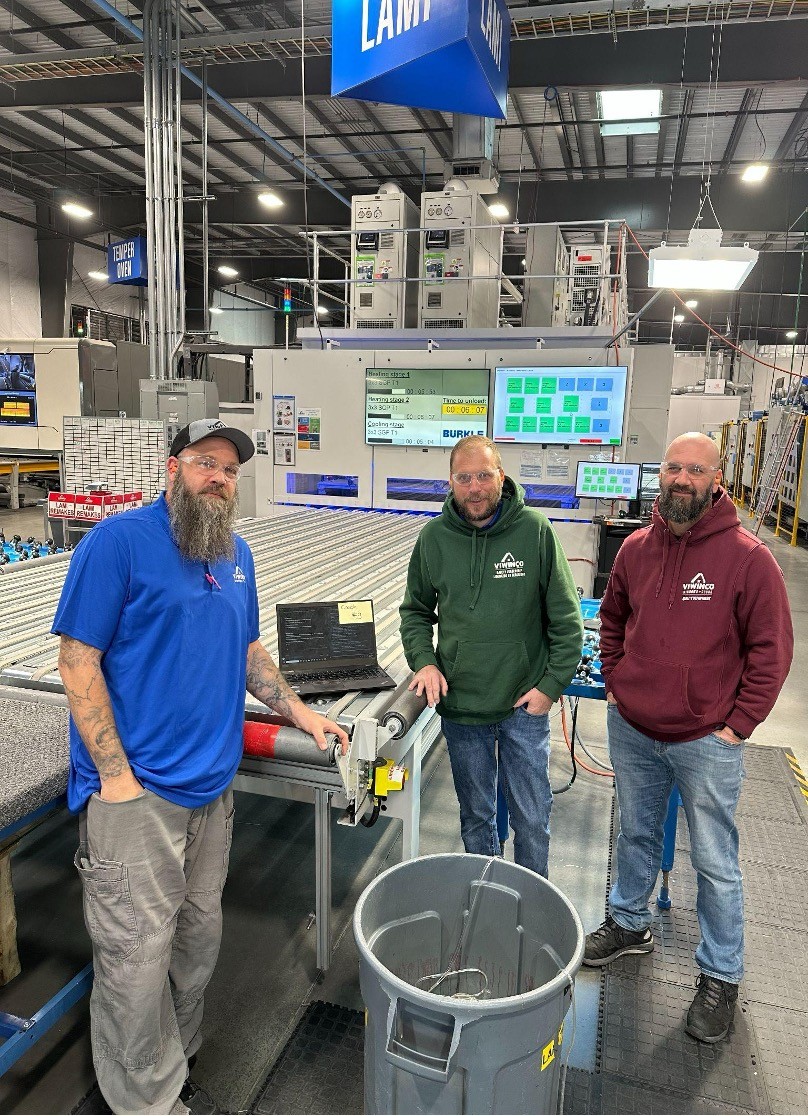
Viwinco's Jeff Prince, Lamination Senior Supervisor; Andrew Buczewski, NGS Manager; and Greg Niles, Quality Engineer, are joined by "Coach #3" on the laptop.
[1] Donald J. Wheeler, Understanding Variation (SPS Press Inc., 1993).

