Deployed or Developed: We Have Seen This Play Before
The choice between renting expertise and building it is a century-old decision, and both experiments have run at scale. Only one of them compounded.
Tyson Heaton
The choice between renting expertise and building it is a century-old decision, and both experiments have run at scale. Only one of them compounded.
This is the second part of a series1 on the forward deployed engineer. Part 1 followed the money pouring into the role, described Varick Agents CEO Vasuman Moza’s account of what the work involves, and asked who keeps the learning those engineers extract. It ended on the claim on which this whole series rests: there is one capability you never rent, and it is the ability to see and improve your own work.
One more scene from Varick is worth mentioning. The company’s answer to its own burnout was to build, in stages, an internal agent for its forward deployed engineers. The first stage ingests the client’s documentation and meeting notes and answers the questions an engineer would otherwise burn days chasing: who owns which process, whether the Sarah in one system is the Sarah in another. The second sits alongside the engineer inside the platform while the workflow is built, prompting about the edge cases nobody asked about and checking the process graph against the real process. A third stage, still in development, would handle small client requests on its own. Notice what happened. Under load, the vendor put improvement capability next to its own people doing the work, inside its own firm. They rediscovered the principle under pressure. The arrangement they sell is different.2
None of this is new. Frederick Winslow Taylor’s contribution to management went well beyond the stopwatch. He applied the scientific method to business processes and much of that work was sound. Bundled with it was a structural choice: take the planning of work away from the people performing it and hand it to a department that studies them. His disciples made the separation permanent, an industrial engineering department whose job was to determine the method and hand it down. Eighty years later the same move arrived with a computer on every desk, and business process reengineering promised radical redesign by central teams working from process maps. I have written elsewhere about how that ended.3
Taylor also had a word for what workers did in response. Soldiering: the deliberate holding back of effort by people who had worked out that full disclosure of their methods would be used against them.
The shape recurs because it is easy to buy. Hire the best available experts to determine how your people should work. The alternative has been available the whole time and is rarely chosen: keep expertise and management control as a thin layer whose job is to support, and put the capability to improve the work next to the people doing it.
The sin is not in the hiring of an expert. The sin is being willing to invest more in the external expert than you would ever consider spending on the people who do the work.
Every one of these waves produced expertise organizations genuinely needed. But that ratio is the decision, and it tells your people how human-centric you actually are.
The sin is not in the hiring of an expert. The sin is being willing to invest more in the external expert than you would ever consider spending on the people who do the work.
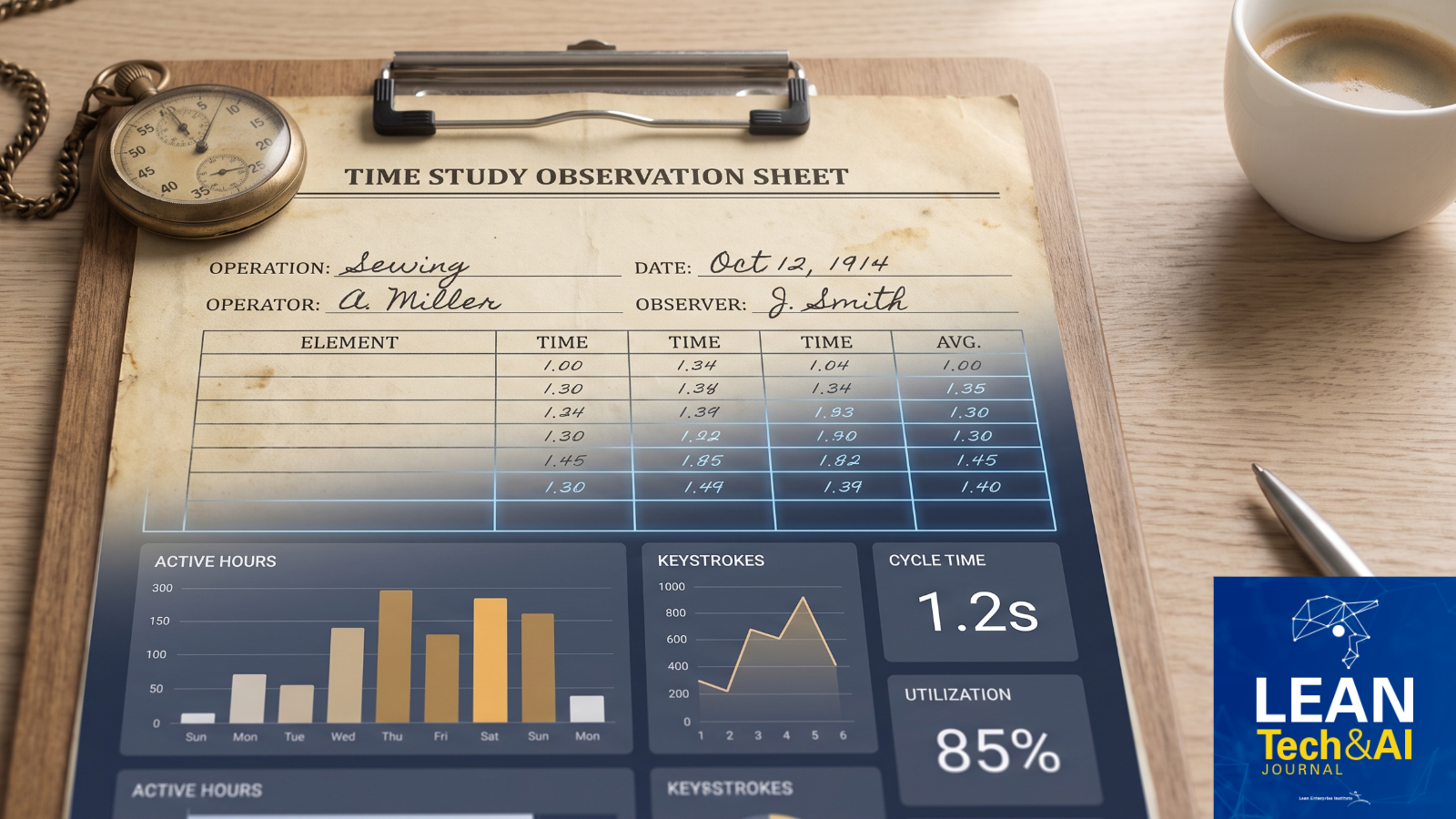
Telemetry is the new stopwatch, and the forward deployed engineer is the new process expert with the clipboard. The starkest version surfaced at Meta this spring, and no vendor was involved. It was the employer running the extraction move on its own payroll. In April, the company began installing software on U.S. employees’ laptops that captured keystrokes, mouse movement, click locations, and periodic screenshots. With no opt-out, this approach was presented publicly as a way to teach AI agents how people use software.4
In audio from an April 30 all-hands, attributed to Mark Zuckerberg, Meta founder and CEO, and not authenticated by Meta, the reasoning was plainer: the models learn by watching very capable people work, and the company’s own strong engineers made better subjects than outside contractors.5 An internal petition against the program said executives had held exemptions from the start,6 and European staff were exempt under General Data Protection Regulation.7 More Perfect Union published the audio on May 19. On May 20, roughly 8,000 employees received layoff notices.8
A lawsuit filed in July by 26 employees alleges the behavioral data fed the performance scoring used to decide who was laid off.9 Meta denies that AI made those decisions.10 The documented sequence is enough on its own: study your strongest performers in order to encode their method, then reduce the population you studied.
Soldiering came back on schedule, and not only at Meta. A digital executive at a European automaker surveyed his organization and found it split cleanly in half. Half were not using AI at all. Half were using tools nobody had sanctioned and were reluctant to say so. We call that second-half shadow AI, which obscures who those people usually are. The heaviest users are frequently the ones who went out and bought their own tools, which means an organization’s most motivated learners are the ones operating outside its view.
Knowledge workers often keep their improvements to themselves on purpose, because they can see what disclosure buys them. Show the organization how you cut a four-hour task to 20 minutes and you are handed the job of teaching everyone else to do it, you are expected to take on more, and you may be told you should not have been using that tool. Teaching the job rarely pays better than doing the job. Neither does disclosing it. Taylor treated this as a defect of character. It was arithmetic then, and it is arithmetic now.
Some executives get this half right. They read the extraction argument from Part 1, conclude the answer is to stop renting, and hire the forward deployed engineers onto their own payroll. Which solves something. The learning stops leaving the company. It does not stop leaving the domain. The process knowledge still gets interviewed out of the people who hold it and lands in a central team that owns the tooling, the graph, and the improvement loop. You have defended the perimeter and rebuilt Taylor’s planning department behind it. Same separation, shorter commute.
There is a second separation hiding underneath the first. Improvement is two kinds of work. There is the work of finding a better method. Then there is the work of balancing customer demand against the pace of a work group, so that what the better method frees up becomes capacity rather than idle time or a layoff. The second is leadership and management work, and the supply of people who can do it shrinks every year because the territory has been ceded piece by piece. Taylor’s department took the method from the worker. The systems that followed took the balancing from the manager: the schedule on the factory floor, the queue, and the assignment of work in the office.
And much of the office territory was never held in the first place because the work fought the discipline that came for it. Nobody ever did the industrial engineering on the invoice Sarah passes to Chris while four days of cycle time disappear. Industrial engineering ran on repetition and a visible cycle, and knowledge work offered neither: wide variation between workers, wider variation between instances, the cycle hidden inside somebody’s head. The clipboard had nothing to write down. Digitize the workflow, and the work leaves a trace. Offload a step to a model, and the variation that lived in Sarah’s head moves into a machine, where it can be counted. Nobody could measure what the handoff cost or what the group could carry. Now anyone can.
The forward deployed engineer does that measuring on arrival, bundled into the role, which is a large part of why so much of what gets sold as AI return is really return on attention. Some work still fights back, the creative and the novel, but the routine center of the office does not. Ceded or never held, the demand math is out of the manager’s hands, and an improvement has nowhere to land. The 20 minutes somebody finds defaults to a smaller headcount, the only lever left in the room. Territory that resisted engineering for a century is being surveyed for the first time, by whoever arrives first.
The Experiment that Went the Other Way
We have run the other version of this at scale, and we have the numbers.
In 1940, American industry faced a staffing problem. Demand was exploding, experienced people were being pulled away, and the work had to be done by whoever remained. The obvious answer was to hire more experts. There were no more experts.
Training Within Industry (TWI) went the other way, pushing method down to the supervisors who already held the domain. TWI consisted of three programs, each learnable in 10 hours: how to instruct a job, how to handle relations with people, how to improve a method. By the time the service shut down in 1945, it had reached some 16,500 plants and issued more than 1.6 million certifications to the supervisors it trained.11 Then, in most places, it evaporated. That matters more than the reach. TWI persisted only where it had been built into a permanent management system. Everywhere it was bolted on, it came off.
Where it was built in was Toyota, which did not answer the need for industrial engineering by hiring an army of industrial engineers. It built a smaller version of one into the team leader, next to the work. Standardized work was not handed down for compliance. It was the current best method, held by the people performing it and revised by them when they found something better.
TWI persisted only where it had been built into a permanent management system. Everywhere it was bolted on, it came off.
This is not an argument against specialists. Toyota kept industrial engineers, and rebalancing takt time across a line requires a vantage point no single team possesses. The question is never whether a central function exists. It is whether it exists to enable the people doing the work, right down to who is allowed to open the document and change it.
None of which is a museum piece. Art Smalley recently documented what happened at Toyota’s Miyoshi plant, where in 2018 two members of the Quality Control division were handed a deliberately vague assignment: there is this thing called AI, why don’t you try something with it. They taught themselves machine learning. What blocked them was not the technology. Company PCs blocked programming setups, and software downloads required approval, and one of them recalled sending more than 100 emails just to obtain permissions. In 2019, they went to the plant general manager and secured part of a meeting room with their own network line, separate from company infrastructure. An outsourcing quote for the work they went on to do came in at over 100 million yen. They built it with Raspberry Pi boards, USB cameras, and inexpensive lenses for under 10,000 yen in components.12
The wall I ran into on a Tuesday afternoon this year, a locked-down enterprise AI deployment that steered every integration question to the core software group, is the one they hit at Toyota eight years earlier.
One of those two Toyota engineers named the actual constraint: “Anyone can build an AI inspection model on a PC if they put in the study,” Okuyama said. The real challenge comes after, in getting the model into equipment already running on the factory floor. Building the model was the learnable half. The integration half was solely due to his partner Furutani’s 10 years in Production Engineering, knowledge that existed nowhere outside the company and could not be hired in.
It had to be grown, and the growing was no accident: a deliberate assignment, and a management layer that made room when the control layer would not. Every organization has that wall. The final part of this series is about building it.
Develop the skill, don’t rent it.
Lean AI Basics gives your practitioners a repeatable framework for putting AI to work in lean, taught live by Art Smalley. Two sessions, online. See dates and register.
This series was researched and drafted with AI assistance.
“AI tools for Forward Deployed Engineering,” AI Engineer World’s Fair, San Francisco, June 30, 2026.
Tyson Heaton, “The Reengineering Is Coming,” The Lean Post, May 11, 2026.
Katie Paul and Jeff Horwitz, “Meta to start capturing employee mouse movements, keystrokes for AI training data,” Reuters, April 21, 2026.
Meta all-hands audio, More Perfect Union, May 19, 2026.
Ella Chakarian, “Meta hits pause on tracking employee keystrokes to train AI after internal leak,” Fast Company, June 23, 2026.
Liz Carolan, “Meta’s Worker Surveillance Tests EU Rules on AI and Labor,” Tech Policy Press, May 2, 2026.
Eli Tan, Kalley Huang, and Mike Isaac, “Meta Lays of Off 8,000 Employees, as A.I. Casualties Mount,” New York Times, May 19, 2026.
Barbara Ortutay and Alexandra Olson, “26 Meta employees sue, alleging AI-driven layoff picks hit workers on medical and parental leave,” Associated Press, July 15, 2026.
Akshay Puri, “How Meta Chose Workers for Layoffs: Sworn Court Filing Reveals the Decision Process,” International Business Times UK, July 27, 2026.
War Manpower Commission, The Training Within Industry Report, 1940-1945, September 1945.
Art Smalley, “Toyota’s Investment in AI Capability,” The Lean Post, Aug. 5, 2026, April 3, 2026.
About the Author
Tyson Heaton
Org Strategy
Tyson Heaton spent 15 years running operations in manufacturing at JBS, Schreiber Foods, and Greencore, learning lean on the floor before moving into enterprise technology leadership at O.C. Tanner. The frustration he found there became a throughline: organizations that had mastered continuous improvement on the shop floor were treating their technology layer as a black box, a dependency to manage rather than a capability to master. He now leads LEI's LeanTech/AI initiative, working with organizations done accepting that tradeoff -- the work is moving faster than most can keep up with, and he'd rather be part of sharpening that thinking than watching from the side.