From 40 Hours to 30 Minutes: How AI Will Remake the Shopfloor and Empower Workers
A month ago, I spoke with an engineer who spent 40 hours drafting a meticulous time study of a 20-hour custom fabrication job. He painstakingly analyzed 18 timelapse videos, at times scrubbing frame by frame, to mark each work element, bit of waste, and their durations. In total, he recorded nearly 1,000 rows in Excel detailing how the operator spent his time.
Matthew Savas
A month ago, I spoke with an engineer who spent 40 hours drafting a meticulous time study of a 20-hour custom fabrication job. He painstakingly analyzed 18 timelapse videos, at times scrubbing frame by frame, to mark each work element, bit of waste, and their durations. In total, he recorded nearly 1,000 rows in Excel detailing how the operator spent his time.
But after 40 hours of all this work, the operator’s job hadn’t changed at all.
The 40-hour analysis was a requisite, gruesome hill to climb to simply see the job and begin to think about where it could be improved.
Following a talk I gave about AI at the Lean Enterprise Australia Summit, the company’s operations leader invited me to conduct an experiment to find out if AI could speed up this work.
The answer was decidedly “Yes.”
A combination of Claude, Gemini, and Codex executed the same study in 30 minutes for $4 and achieved median accuracy of 79% across the 18 videos—peaking at 90% in three of the videos—benchmarked against the engineer’s time study.
Failures were caused by a camera angle that did not capture the entire work area, obstructed hands, and difficulty identifying some tools. The team quickly devised several countermeasures to address these problems in preparation for a second experiment.
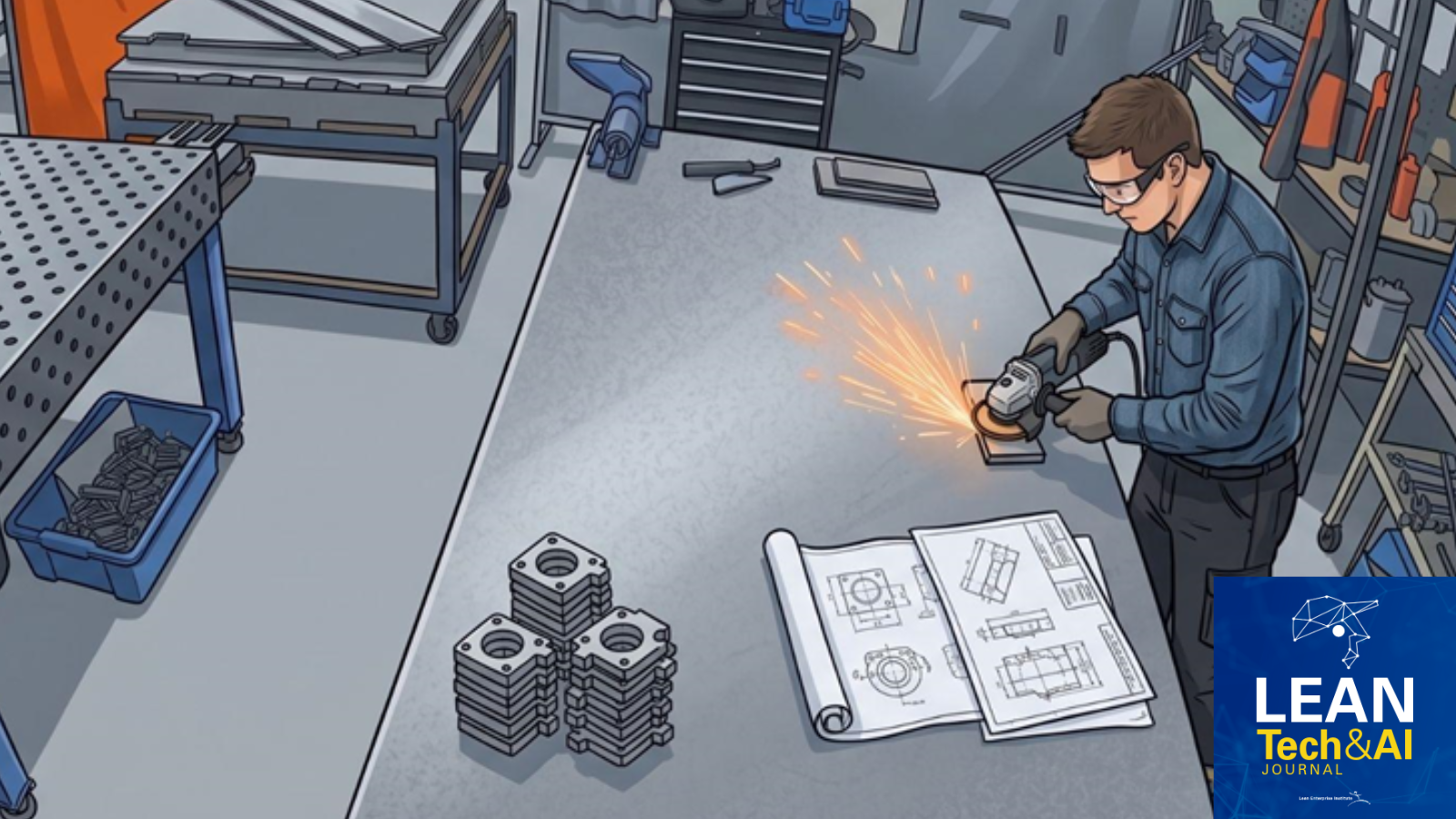
The AI did not just execute the analysis. With a bit of prompting, Opus 5 built an application displaying it that looks better than most enterprise SaaS. The image below is a recreation of the application using an illustration to disguise the company. Anyone could learn to use it with a few minutes of training.
Had the engineer had this tool, he could have spent those 40 hours working alongside the operator to improve a job they could see together.
A massive Excel spreadsheet is hardly an inviting way to engage someone. It’s intimidating, clumsy, and doesn’t even display work because the video is not in the sheet. If the engineer wants to show the operator how he spent nine minutes searching for a tool, he has to match row 538’s timestamp to one of 18 videos, then scrub to the correct time. Ironically, the 40-hour time study begets the waste of using the time study!
More importantly, with some extended training, the engineer and even an operator could learn to build this tool themselves. The latest AI models—Opus 5, Fable, and Sol—are so capable that the bottleneck to building sophisticated tools is now you.
Imagine an engineer working alongside an operator to build bespoke tools that solve precisely their problems: no expensive third-party vendors that cost tens of thousands of dollars, painful procurement, endless meetings designing the final system, a deployment that’s buggy and not what you expected, and, finally, a system that becomes digital wallpaper that users endlessly work around with shadow Excel sheets.
A small team of people close to the work can build a working prototype in hours and continuously iterate their own solutions.
Is an operator more likely to use a tool he designed himself or one IT ships to him? How many times can a company afford to assign a skilled engineer to a 40-hour time study? How many skilled engineers would it take to analyze the entire shop?
Three effects will enable much more rapid improvement cycles:
AI can scale analysis across an entire floor and work continuously, providing immediate feedback to the whole team.
Engineers are freed from monotonous, time-consuming studies so they can focus their effort on improving the condition on the floor.
Operators participate in the system’s design so they are much more willing to use it.
Now, there is the risk of management using these tools for mass surveillance rather than mass empowerment. Leadership should establish principles governing their use and model them. The lean mantra “Go see, ask why, show respect” will be more important than ever in the age of AI, as management can deploy legions of bots observing every second of every working inch of their facilities. Just see the recent article by Tyson Heaton, LEI Executive Director of LeanTech/AI, about how Meta is capturing employee keystrokes. Still, the opportunities outweigh the risks. Leaders who create the environment for bottom-up solutions will not just see tremendous business results but leaps in engagement.
"Leaders who create the environment for bottom-up solutions will not just see tremendous business results but leaps in engagement."
Enterprise software and MRP systems aren’t going anywhere yet. But new types of software, built by non-technical teams, will emerge and transform how work gets done. It will eliminate drudgery and share performance feedback so teams can rapidly improve. Because the people doing the work will build these systems, their utility will skyrocket.
The days of creating the thousand-row Excel sheet are coming to a close, replaced by innovative solutions designed on the floor by the floor.
Develop the skill, don’t rent it.
Lean AI Basics gives your practitioners a repeatable framework for putting AI to work in lean, taught live by Art Smalley. Two sessions, online. See dates and register.
About the Author
Matthew Savas
Matt Savas is the founder of Kaizumi, an AI-powered lean training platform. Prior to Kaizumi, Matt worked at the Lean Enterprise Institute and Lean Global Network for over a decade.